
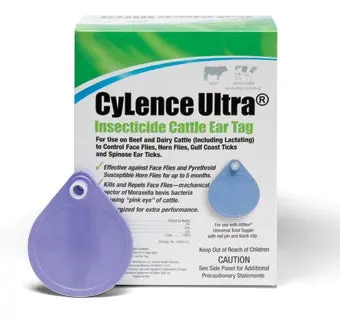
CyLence Ultra Insecticide Cattle Ear Tag
CyLence Ultra® insecticide cattle ear tag controls face flies, horn flies, Gulf Coast ticks and spinose ear ticks on cattle, including lactating dairy cattle. Flies are often an underestimated menace to cattle producers and can significantly impact the well-being and economic value of the herd. Flies interrupt grazing and can reduce weight gain. In fact, horn flies can reduce yearlings' weights by up to 18%. Up to $68/head can be lost due to overpopulation of flies, and a total industry loss of $1 billion for the entire United States. No producer wants to lose money, especially when there is a solution to the problem.
Beyond economics, flies impact cattle comfort and health and cause:
Agitation
Itching
Disease Transmission
These impacts can reduce weight gain and milk production, making fly control ear tags an important part of a multiple-point-defense strategy.
Key Product Benefits:
Effective against face flies and pyrethroid-susceptible horn flies for up to five months.
Synergized fifth-generation pyrethroid insecticide beta-cyfluthrin.
Kills and repels face flies, a mechanical vector of Moraxella bovis bacteria which is a cause of pink eye in cattle.
Can be used on beef and dairy cattle including lactating.
Utilizes the Allflex® Universal Total Tagger.
Package Sizes:
One box contains two 10-tag pouches. 20 tags, 0.5 oz./tag.
Dosage:
All mature animals in the herd should be tagged.
For adequate control of horn flies, attach one tag per animal.
For optimal control of face flies, horn flies, Gulf Coast ticks and spinose ear ticks, attach one tag to each ear (two per animal)
Indications
CyLence Ultra Insecticide Cattle Ear Tags are for use on beef and dairy cattle, including lactating cows, to control face flies, horn flies, Gulf Coast ticks and spinose ear ticks.
Cautions
Avoid contact with eyes, skin or clothing. See product label for complete product information, indications and application instructions.
Storage
Do not contaminate water, food or feed by storage or disposal.
Store in a cool place in the original container. Opened pouches containing ear tags should be resealed for storage.
Administration
Proper application and removal of ear tags help optimize their effectiveness.
To put the tags on the animal properly, they must be positioned on the center of the front side of each ear. Apply the tag between the second and third rib cartilage by following these steps:
Step 1: Disinfect pliers prior to use. Place male button onto pin until it projects through the tip.
Step 2: Slide tag under the clip of the pliers by depressing the lever.
Step 3: Position the tag in the center portion of the front side of the ear.
Step 4: Apply the tag between the second and third rib cartilage.
Application recommendations:
Optimum control of indicated pests: one tag/ear (two per animal)
Adequate control of horn flies: one tag/animal
The tag should hang below the animal’s ear.
Be sure to remove after five months, at the end of the fly season or prior to slaughter.
CyLence Ultra® insecticide cattle ear tag controls face flies, horn flies, Gulf Coast ticks and spinose ear ticks on cattle, including lactating dairy cattle. Flies are often an underestimated menace to cattle producers and can significantly impact the well-being and economic value of the herd. Flies interrupt grazing and can reduce weight gain. In fact, horn flies can reduce yearlings' weights by up to 18%. Up to $68/head can be lost due to overpopulation of flies, and a total industry loss of $1 billion for the entire United States. No producer wants to lose money, especially when there is a solution to the problem.
Beyond economics, flies impact cattle comfort and health and cause:
Agitation
Itching
Disease Transmission
These impacts can reduce weight gain and milk production, making fly control ear tags an important part of a multiple-point-defense strategy.
Key Product Benefits:
Effective against face flies and pyrethroid-susceptible horn flies for up to five months.
Synergized fifth-generation pyrethroid insecticide beta-cyfluthrin.
Kills and repels face flies, a mechanical vector of Moraxella bovis bacteria which is a cause of pink eye in cattle.
Can be used on beef and dairy cattle including lactating.
Utilizes the Allflex® Universal Total Tagger.
Package Sizes:
One box contains two 10-tag pouches. 20 tags, 0.5 oz./tag.
Dosage:
All mature animals in the herd should be tagged.
For adequate control of horn flies, attach one tag per animal.
For optimal control of face flies, horn flies, Gulf Coast ticks and spinose ear ticks, attach one tag to each ear (two per animal)
Indications
CyLence Ultra Insecticide Cattle Ear Tags are for use on beef and dairy cattle, including lactating cows, to control face flies, horn flies, Gulf Coast ticks and spinose ear ticks.
Cautions
Avoid contact with eyes, skin or clothing. See product label for complete product information, indications and application instructions.
Storage
Do not contaminate water, food or feed by storage or disposal.
Store in a cool place in the original container. Opened pouches containing ear tags should be resealed for storage.
Administration
Proper application and removal of ear tags help optimize their effectiveness.
To put the tags on the animal properly, they must be positioned on the center of the front side of each ear. Apply the tag between the second and third rib cartilage by following these steps:
Step 1: Disinfect pliers prior to use. Place male button onto pin until it projects through the tip.
Step 2: Slide tag under the clip of the pliers by depressing the lever.
Step 3: Position the tag in the center portion of the front side of the ear.
Step 4: Apply the tag between the second and third rib cartilage.
Application recommendations:
Optimum control of indicated pests: one tag/ear (two per animal)
Adequate control of horn flies: one tag/animal
The tag should hang below the animal’s ear.
Be sure to remove after five months, at the end of the fly season or prior to slaughter.